The Heart Awakens to Its Treasure

“Pray at all times in the Spirit.”
Ephesians 6:18. Read Ephesians 6:10-19

Those words in Ephesians 6:18 can immediately make us ask, How do I do that?

But Scripture begins somewhere else in 6:10

“Be strong in the Lord and in the strength of His might.”

Before we are told how to stand, we are told where the strength to stand comes from.

The battle is beyond what we see, and the strength required is beyond what we possess.

So prayer cannot simply be my assessment of circumstances brought before God: Change this. Remove that. Give me this outcome.

What if I cannot see the whole battle?

What if I do not even know what should be prayed?

Romans 8 tells us plainly: “we do not know what to pray for as we should.”

But the Spirit helps our weakness.

Perhaps that begins to open Ephesians 6:18:

Praying in the Spirit is not trying to persuade God to accomplish what is on my mind, but depending upon the Spirit to bring my praying increasingly into agreement with what is on God’s mind.

This is not passivity.

Ephesians says: stand, take up, pray, watch, persevere.

It is dependent participation.

Jesus said:

“Remain in Me… for apart from Me you can do nothing.” John 15:5

Then:

“If you remain in Me, and My words remain in you, ask…” John 15:7

Notice the movement.

Remain.
His words remain.
Ask.

Prayer arises within fellowship.

We remain because we cannot see, understand, pray or stand independently of Him.

The branch does not manufacture life.

And Psalm 37 takes us deeper:

“Delight yourself in the LORD.”

Before the desires comes delight.

Fellowship does not merely change what we ask.

Fellowship transforms the heart from which the asking comes.

As we remain, we know Him.

As we know Him, we delight in Him.

As we delight in Him, our desires increasingly come under His Word and His will.

As desire is shaped in fellowship, asking is shaped too.

This is not a formula.

It is relationship.

“Pray at all times” can sound like an impossible demand for continuous religious activity.

But perhaps we have missed its heart.

“Pray at all times in the Spirit” is not a summons to continuous religious performance. It is a summons to continuous dependence upon God, expressed through prayer in fellowship with Him.

Prayer is not merely something we do in His presence.

Prayer flows from living in His presence.

Through the Son.

In the Spirit.

To the Father.

And that fellowship does not turn inward and stop with us.

Ephesians continues:

“with all perseverance and every request for all the saints.”

Prayer in the Spirit is not merely an inward spiritual experience.

The Spirit turns us toward the concerns of God, and God’s concern includes His people.

We are not standing alone.

Our brothers and sisters need His strength too.

So dependence becomes fellowship, fellowship bears love, and love expresses itself in intercession.

There is another danger.

We could understand all this correctly and turn it into a new technique:

Here are five things to do so that you can pray in the Spirit.

But that would contradict the journey.

Even transformation must not become the pursuit.

Second Corinthians 3:18 tells us that as we behold the glory of the Lord, we are transformed into His image by the Spirit.

We behold.

Transformation is consequence.

Christ is central.

The branch does not stare at its fruit.

It remains in the Vine.

Christ is the pursuit.

Everything else is fruit.

Jesus said:

“where your treasure is, there your heart will be also.”

And perhaps here we reach the heart of it all.

God Himself is the Treasure.

Not merely answered prayer.

Not spiritual strength.

Not discernment.

Not even transformation.

Him.

If He is our Treasure, our hearts are drawn toward Him.

We commune with Him.

Delight in Him.

Depend upon Him.

Pray in fellowship with Him.

Then Psalm 139 opens a beautiful window in verse 18:

“When I awake, I am still with You.”

I sleep.

I awake.

And I am still with You.

Not awakening first to religious duty.

Not awakening to technique.

Awakening in the consciousness of fellowship with God.

The heart awakens to its Treasure.

But we do not yet see Him face to face.

“For now we see in a mirror dimly, but then face to face.” 
1 Corinthians 13:12-13

Now we live by faith.

Now we hope.

Now we love the One we cannot yet see face to face.

Faith trusts Him.

Hope looks toward Him.

Love delights in Him.

And one day:

The Treasure we have loved by faith and hoped for is before us, face to face.

Faith has done its work.

Hope has reached fulfilment.

Love remains.

All through Ephesians 6 we were told to stand.

Stand in His strength.

Stand in His armour.

Stand in the evil day.

But standing is not the destination.

In this age, in His strength, we stand.

An age is coming when the struggle is over and the Treasure is before us.

Then the posture changes.

In this age, in His strength, we stand.
In the age to come, in His presence, we fall.

Not in defeat.

In worship.

“Amen, blessing and glory and wisdom and thanksgiving and honor and power and might, be to our God forever and ever. Amen.” 
Revelation 7:12, NASB 2020

Explore more posts from Spread The Truth by clicking the logo.
The Heart of a Leader

The heart of the matter is where our heart is. Is it resting in Christ?

“So, as those who have been chosen of God, holy and beloved…” 
Colossians 3:12 • Read Colossians 3:12–17

Before we lead we belong

Leadership can fill our minds with what we have achieved, what remains unfinished and what others expect. In the middle of it all, we can lose sight of the One we follow.

Paul begins in 3:12… chosen of God, holy and beloved.

Before responsibility comes belonging. Before we are leaders, we are His.

Our role is entrusted to us. Our identity is received from God in Christ. This is not a call to try harder to become better leaders. It is an invitation to keep following our Leader together.

What are we becoming. Our doing must flow from being and becoming in Christ.

His concern is not merely what we have accomplished or are accomplishing, but what we are becoming as we follow Him.

Compassion, kindness, humility, gentleness, patience, forgiveness and love are not techniques. They are Christlike character.

Paul speaks of one another and one body. This character becomes visible in our shared life: how we listen, bear with weakness and forgive. What is our leadership revealing about where our hearts rest?

Christ remains the Leader

His peace rules | His Word dwells | His name governs

We have responsibility, but He has authority. We may lead His people, but they remain His people.

We never grow beyond needing His Word or depending on His care. Before we lead, we follow. As we lead, we follow. While we lead others, we keep following Him.

Look again at His heart

Yet the searching question about our hearts should lead us to Jesus, rather than leave us absorbed in ourselves.

If you are tired, frustrated or carrying a burden others cannot see, pause. Listen to the Leader Himself:

“Come to Me, all who are weary and burdened, and I will give you rest.” Matthew 11:28

A good leader follows the Leader.

Hear the tenderness of His invitation. He calls us to Himself, to take His yoke and learn from Him.

He is “gentle and humble in heart” Matthew 11:29.

Look at Him before measuring yourself again. Bring Him the unfinished work, the difficult conversation and the fear of letting people down. Let His Word speak into the place where your heart has become anxious or self-reliant.

In His presence, ask:

Lord Jesus, is my heart yielded to You?

Lord Jesus, draw my heart back to You.

Where service has become function without fellowship, restore my delight in You. Where I have carried what belongs to You, teach me to trust Your care.

Let Your peace rule, Your Word dwell and Your love shape our life together. As I lead others, keep me following You.

You lead. We follow.

Amen.


Explore more posts from Spread The Truth by clicking the logo.

Only Believe

When the news seems to end hope, Jesus still has a word to speak.

“Do not be afraid, only believe.” 
Mark 5:36 • Read Mark 5:21–43

The father who needs Jesus

Jairus falls at Jesus’ feet. His little daughter is dying. His position as a synagogue official cannot save her. He pleads for Jesus to come, lay His hands on her, and restore her to health and life.

Luke adds that she is his only daughter. Jesus goes with him. A large crowd follows, pressing close as they make their way towards the house.

Then another sufferer approaches. A woman has endured bleeding for twelve years, as long as the girl has lived.

Treatment has exhausted her resources and left her worse. She has heard about Jesus. She believes that even touching His clothing will be enough.

The daughter who receives peace

Her body is healed, but Jesus has more to say to her.

She touches His garment, and immediately the bleeding stops. Jesus turns to find the person who touched Him. She comes fearing and trembling and tells Him the whole truth.

He calls her Daughter, affirms her faith, and sends her in peace. She receives personal assurance from the One whose power has restored her.

While Jesus is going to one man’s daughter, He gives this suffering woman His full attention. His authority carries tender care.

The news that seems to end hope

While Jesus is still speaking, messengers arrive. Jairus’ daughter has died. Why trouble the Teacher any further?

Their words assume that death has placed her beyond His help. Jesus immediately tells Jairus not to fear, but to believe.

Jairus now faces two voices: the report that closes hope and the Lord who calls him to trust. Jesus’ word comes before the outcome.

The Lord who speaks life

At the house, Jesus takes the girl’s hand and commands her to rise. Immediately she gets up and walks. He then asks that she be given food.

The One who commands the storm and delivers the oppressed also rules over sickness and death. His care reaches even the small and ordinary.

Romans 4:18–21 illuminates this trust. Abraham believed in hope against hope, convinced that God could fulfil His promise despite circumstances that seemed to rule it out.

Hope rests in the One who speaks and can fulfil His word.

These miracles reveal Jesus’ authority. They do not promise immediate healing in every illness.

Look again at Jesus.

His life-giving authority extends over sickness and death.

Our risen Lord promises to raise His people to life (John 6:40). Our final hope rests securely in Him.

What fear are you carrying before Him today?

Trust Jesus, even when circumstances appear to extinguish hope.

Bring Him your helplessness. Hear His word in Scripture. Let His revealed character shape your prayer when you cannot see what comes next.

Then share what this passage reveals, so another person may find encouragement in Him.

Lord Jesus, help me trust You.

You are the Lord of life, and Your care is tender.

By Your Spirit, steady my heart when the news is frightening. Help me hear Your word and rest my hope in You. Give me courage to make Your goodness known. Amen.

Proclaiming Jesus Restoring Mercy

The voice once heard crying among tombs now proclaims Jesus.

“Go home to your people and report to them what great things the Lord has done for you, and how He had mercy on you.” 
Mark 5:19 • Read Mark 4:35–5:20

The Lord whom darkness cannot resist

After Jesus calms the storm, the disciples ask who He is. Across the sea, Mark continues to reveal the answer. The One whom wind and waves obey also commands the forces of darkness.

A man lives among tombs, crying out night and day and cutting himself with stones. No one can subdue him. He breaks chains, yet remains captive.

The spirits recognise Jesus, but resist His intervention. Their name reveals the extent of the oppression: they are many.

Their multitude cannot overrule Him. They must plead for permission. Luke adds their fear of the abyss; Matthew records their anticipation of judgment.

The mercy that restores

Jesus reveals God’s sovereign authority and restoring mercy.

Before the people sits the man, clothed and in his right mind. Luke places him at Jesus’ feet. His dignity is visible again. The scene of torment has become a scene of peace.

Jesus calls this mercy. His compassion has acted where human strength could not deliver.

The man does not earn this deliverance through a response Mark records beforehand. Mercy comes first. His own response becomes visible after restoration.

The presence we welcome or resist

The people become afraid and ask Jesus to leave. The restored man begs to be with Him. Later hearers are amazed.

These responses are different. Recognition, fear and amazement can accompany an encounter with Jesus without becoming trusting obedience.

But let us look beyond their responses to the Lord before them. His authority and mercy belong together. The One who commands the spirits is the One who restores their captive.

Sent to make His mercy known

The man wants to accompany Jesus. Jesus sends him home to tell his people what the Lord has done and how He has shown mercy.

His desire is good, but Jesus’ word directs its expression. He goes and proclaims throughout the Decapolis what Jesus has done.

Jesus names the Lord’s mercy; the man names Jesus. His proclamation makes known the One who restored him.

The application is already in Jesus’ command.

Although the people ask Jesus to leave, He leaves a witness among them.

Look again at Jesus.

Behold His authority and His merciful heart.

The man’s restored life draws our eyes to Him. His testimony carries that revelation to others.

What will we do with the mercy we have received?

Begin with the people around you. Speak truthfully of Him. Sharing this passage may help someone else behold His glory.

Let worship find expression in speech, action and adoration, shaped by His word.

Lord Jesus, direct my response. I worship You, the Lord of all authority and the God of all mercy. By Your Spirit, make my heart willing to obey. Help me tell what You have done and how You have shown mercy. May others see Your glory through my testimony. Amen.


Explore more posts from Spread The Truth by clicking the logo.

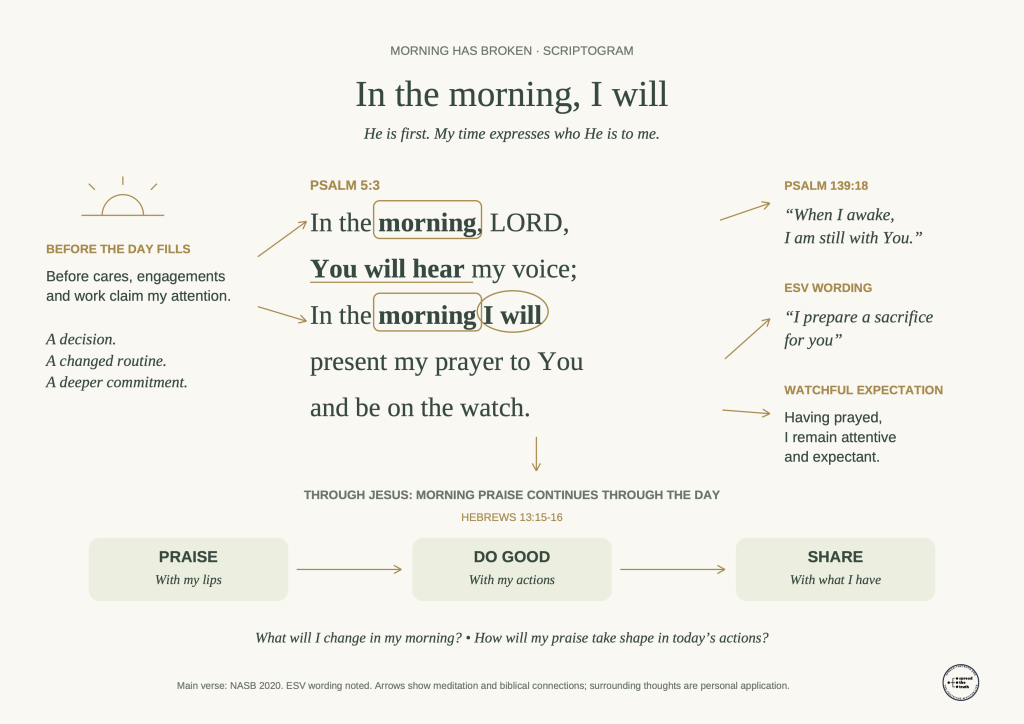
Morning breaks & He is present

In the morning, I will

PSALM 5:3
In the morning, LORD, You will hear my voice;
In the morning I will present my prayer to You
and be on the watch.

YOU WILL HEAR. I WILL COME. A MORNING RESOLVE.

01 I will come before the day fills

Morning is repeated. My response is deliberate: before cares, engagements and work fill my

attention, I will turn to the Lord who hears.

What needs to change so that this resolve has a real place in my morning?

02 I will bring my prayer and praise

I will prepare what I bring before Him. The ESV’s sacrifice wording leads me to Hebrews 13:

through Jesus, my praise is an offering to God.

What will I praise Him for, and what will I place into His hands today?

03 I will watch as I walk through the day

Having prayed, I will remain expectant. As I wait, my morning praise can continue in doing good

and sharing, the sacrifices named in Hebrews 13.

Where can I do good or share today, even when the day becomes demanding?

FROM MORNING PRAISE TO A DAY OF OFFERING

Psalm 5:3, ESV: “I prepare a sacrifice for you”.

Hebrews 13:15-16: Through Jesus, praise, doing good and sharing are sacrifices pleasing to God.

Psalm 139:18: When I awake, I am still with Him.

Praise with my lips in the morning; generosity and goodness through the day.

Lord, You will hear my voice. Before this day fills, I will come to You. Receive my prayer and praise through

Jesus. Keep me watchful, and let my praise continue in the good I do and the gifts I share. Amen.


Explore more posts from Spread The Truth by clicking the logo.

The Pursuit and the Fruit

The branch doesn’t stare at the fruit. It remains in the Vine.

It began with a worship song.

The plea was beautiful:

“Draw me closer.”
“Pull me deeper.”

Yet a question arose.

The song was addressed to the Holy Spirit, but I could not remember hearing the name of Jesus.

That did not immediately make the song wrong.

But it made me stop.

Closer to whom?
Deeper into what?

Let the Word Govern

Music can move us deeply.

Words, melody, repetition and atmosphere can awaken powerful emotions. Emotion is not wrong. Scripture itself is filled with joy, sorrow, longing and wonder.

But being moved is not proof that something is true.

Our emotions can respond to truth, but they cannot determine truth.

So we went to the Word.

Jesus said of the Holy Spirit:

“He will glorify Me...”
John 16:14

The direction became clearer.

The Spirit does not compete with Jesus for our gaze.

He glorifies Jesus.

“Draw me closer” now had direction.

But what about deeper?

What Does Scripture Call Deep?

Paul prays that believers would be strengthened through His Spirit in the inner person, so that Christ may dwell in their hearts through faith.

Then he speaks of comprehending:

“the width and length and height and depth...”
Ephesians 3:18

Depth into what?

The love of Christ.

Biblical depth is not simply greater spiritual intensity.

The Holy Spirit takes us deeper into Christ.

When Experience Becomes the Pursuit

There can be a subtle shift from:

“I want Christ”

to:

“I want the feeling Christian experiences give me.”

Then we begin asking:

Was I moved?
Did I feel God’s presence?
Did I receive something?

Those questions may arise from genuine hunger.

But experience can quietly become what we consume.

And depth becomes confused with intensity.

Emotion may accompany truth. It may beautifully respond to truth.

We may behold Christ and weep.

We may behold Christ and rejoice.

But we may also trust, obey and remain in Him when we feel very little at all.

Christ has not become less true because our emotions are quiet.

Our assurance rests upon what He has spoken.

Even Good Things Are Not the Destination

Transformation.

Obedience.

Surrender.

Holiness.

Fruitfulness.

Spiritual depth.

Even discernment.

All are important.

But none is the destination.

Jesus said:

“I am the way, and the truth, and the life...”
John 14:6

Truth ultimately brings us to a Person.

Jesus.

And suddenly we had arrived again at the Vine.

Don’t Stare at the Fruit

Jesus said:

“Remain in Me, and I in you.”
John 15:4

And something became wonderfully simple.

The branch doesn’t stare at the fruit.
The branch remains in the Vine.

Transformation is fruit.

Obedience is fruit.

Surrender is fruit.

Love is fruit.

Even our emotions can be fruit.

But none of them is the Vine.

Jesus is.

The Vine produces.

The branch abides.

And the Father receives the glory.

The Pursuit and the Fruit

We began with:

“Draw me closer.
Pull me deeper.”

The Word asked:

Closer to whom?
Deeper into what?

The Holy Spirit directed our gaze to the Son.

And in the Son, we saw the Father.

We followed the question through the Word, and the Word led us back to Jesus.

Christ is the pursuit.
Everything else is the fruit.

The journey didn’t terminate in discernment, doctrine, emotion, worship methodology, transformation, or even fruit.

It terminated in the Vine.

And there we remain.

Soli Deo Gloria

Father, thank You for giving us Your Son and Your Spirit.

Holy Spirit, thank You for directing our gaze to Jesus and glorifying Him.

Jesus, thank You for revealing the Father.

Keep our gaze upon Christ. Teach us to remain in Him, trusting Your Word rather than making our experiences the measure of truth. May the fruit come from remaining in the Vine, and may all the glory return to You.


Explore more posts from Spread The Truth by clicking the logo.