Beatitudes – Those who mourn.E2

For the podcast please go to the Spotify channel.

Welcome to the second episode in our series on the Beatitudes. If you haven’t listened to Episode 1 yet, I strongly encourage you to go back and start there.
As a quick reminder: Episode 1 was about the condition, being “poor in spirit”. Today, Episode 2 is about the contrition -mourning. And just to spark your interest, Episode 3 will be about control. There’s a beautiful, natural progression: from condition, to contrition, to control. The Beatitudes are widely regarded as the most profound discourse ever delivered — spoken by Jesus of Nazareth Himself.

Matthew 5:4 tells us:
“Blessed are those who mourn, for they will be comforted.”

Mourning is a state of deep grief. It’s the pain we feel when something valuable has been taken from us.
Being blessed is far deeper than simply being happy. The different states Jesus describes in the Beatitudes are all designed to lead us into true, lasting happiness in God’s kingdom. At first glance, mourning and blessing seem completely at odds — a clear dissonance. But remember what we learned in the last episode: the Kingdom of God is an upside-down kingdom. Its values are radically different from the ways of this world.
This second blessing flows naturally from the first — the poor in spirit. In this episode, we’ll examine mourning in light of the whole counsel of God.
It’s important to understand that not everyone who mourns will be comforted. The promise belongs to the saved — the citizens of God’s kingdom. Those are the ones who will ultimately have the last laugh.
Listen closely: the mourning and weeping we experience now is time-limited. It is not forever. Jesus makes this clear. Let me paint a helpful picture.
Imagine your entire life — whether 70, 80, or even 90 years — placed against the backdrop of eternity.
That lifetime becomes an almost invisible dot on the timeline. Our season of mourning is confined to this short life.
But for those who trust in Jesus, it is exchanged for an eternity with Him. There will be no more weeping with Him!
Luke 6:21 echoes this theme: “Blessed are you who weep now, for you will laugh.”
The Greek word for “mourn” is pentheo. It means to lament, to mourn, to weep, to feel guilt, or to be deeply sad. Mourning doesn’t always require tears. It can be an inward state of the heart, even completely oblivious to people around.
Now, let’s look at five important contexts where the Bible talks about mourning:

First, mourning over our own sin — displeasing God through our wrongdoing. Genuine spiritual mourning is the work of the Holy Spirit. It’s pure grace and not of anything from us, for we do not have the capacity to turn of our own, to God. True mourning however produces repentance — a change of mind and heart, a hatred for sin, and a turning away from it. As 1 John 3, 9 says, no one born of God makes a practice of sin. Godly sorrow leads to repentance, and believers continue in the posture of repentance daily. Do not, mistake this, the practice of sin is a lifestyle, in sin and calls to question, if we were ever saved in the first place. Repentance is a turning away from sin. The understanding here is of vital importance.

Second, mourning on behalf of others — their sin, rebellion, or folly. Jesus Himself wept over Jerusalem:
“Jerusalem, Jerusalem… how often I have longed, to gather your children together… but you were not willing.”
We also see this in Ezra 10 where he mourns for the unfaithfulness of the people. Another example is Paul’s deep anguish for his countrymen. In Romans 9,2 and 3, Paul goes to the extent of wishing, that they would be saved even if it meant a risk to his own position in Christ. Proverbs 24, 11 and 12 challenges us powerfully to rescue those heading toward death. This passage left a lasting mark on me, and changed my heart and thinking.

Third, mourning the loss of loved ones, belongings, or what once stood strong. The Bible records set times of mourning for figures like Jacob, Samuel, and Moses. Yet for believers, we do not grieve like the world. We have eternal hope. As 1 Thessalonians 4, 13 to 18 reminds us, death is not the end for those in Christ. However the greatest joy will be beholding our Saviour face to face.
Fourth, and this is especially moving — our Lord Himself wept at the tomb of Lazarus, in John 11:35. The Greek word used in verse 33 and 38 shows He was deeply moved and agitated. Death is His enemy and this stirred emotions of grief and anger. Death was never God’s design for His beloved creation.
Fifthly, we mourn and even fast for the ones dear to us but spiritually lost. Many mourn for their children. Jesus points this out in Luke 23, 28. Friend, God sees our mourning and He graciously answers in His time.

Why does mourning hold such great value in God’s kingdom? Well, these are kingdom values.
For a start, a contrite, mourning heart is an acceptable, sacrifice, to God seen in Psalm 51, 17.
Secondly, mourning sets the stage for restoration of fellowship. Mourning leads to confession and repentance. God then forgives, restores joy, and fellowship. He longs for this. James 4,8 and 9 along with John 16,20 confirm this understanding.
Thirdly, our relationship with God, cannot grow, without it. James 4, 8 and 9 urges us: “Draw near to God… Be wretched and mourn and weep. Let your laughter turn to mourning and your joy to gloom.”
Intimacy exposes more of our fallen nature. Closer to Him, brighter the light and more of our dark corners illuminated, that need cleansing. Holiness is being worked out, conforming to the image of Jesus and not to the world. This is how we get set apart, exclusively, for Him.
Fourthly, when we mourn, in loss and suffering, the God of all comfort Himself, brings peace, assurance and hope shown in 2 Corinthians 1, 3 to 5. We can now pass this on! With this comfort we have received, we are blessed. But don’t miss this, we become a blessing, for others, because we can now comfort others with the same comfort we have received from the Lord. Remember we can give because we have received. This is how God’s kingdom operates for now, until every tear is wiped away eventually.

And now, the beautiful promise: Our mourning is temporary. It gives way to joy, comfort, and laughter.
Jeremiah 31,13 declares:
“I will turn their mourning into joy; I will comfort them, and give them gladness for sorrow.”
Revelation 21,4 promises:
“He will wipe every tear from their eyes. There will be no more death or mourning or crying or pain, for the old order of things has passed away.”

Friend, don’t lose the scriptural perspective, your position or His power. So, let me leave you with this word of encouragement from 2 Corinthians 4, 17, and this is the NET translation which reads, “For our present troubles are small and won’t last very long. Yet they produce for us a glory that vastly outweighs them and will last forever!
Did you see that? All this, far outweighs, the glory awaiting us.

Heavenly Father, thank You that in Your upside-down kingdom, mourning leads to comfort. Give us tender hearts that mourn over sin — our own and the world’s. Turn our sorrow into joy and use our tears to draw us closer to You and to comfort others. We trust in the hope of eternity with You. In Jesus’ name, Amen.

“Those who sow in tears will reap with songs of joy.” — Psalm 126:5
Hear & Adhere

For a podcast look in the podcast section of this site.

In a world filled with sermons, teachings, podcasts, and endless spiritual content, it has never been easier, to hear the Word of God. Yet the Scriptures repeatedly warn us that hearing alone is not enough!

Jesus made this distinction crystal clear. He didn’t just teach the Word, He lived it. His very sustenance, His deepest satisfaction, was obedience to the Father. Throughout the Gospels and the New Testament, the Holy Spirit confronts a dangerous misconception: that knowledge without action, or profession without obedience, can somehow please God.

This is the heart of Hear and Adhere, a powerful call to move beyond passive listening into active, wholehearted obedience. The Bible, leaves no room, for comfortable illusions. The one who hears, and does not obey, deceives himself. 

The scriptures use several illustrations, to describe the one who claims to know Christ, but does not keep His commandments. May the following truths from Scripture, awaken in us a fresh hunger, not just to hear the voice of God, but to live it out with surrendered hearts. For in hearing and adhering, we discover, the very food that satisfied Jesus, the foundation that withstands every storm, and the intimate knowledge of God that true love produces.

The Bible repeatedly clarifies misconceptions about true spirituality. It is not merely about knowledge, words, or outward religious activity, but about hearing God’s Word, and actively obeying it.

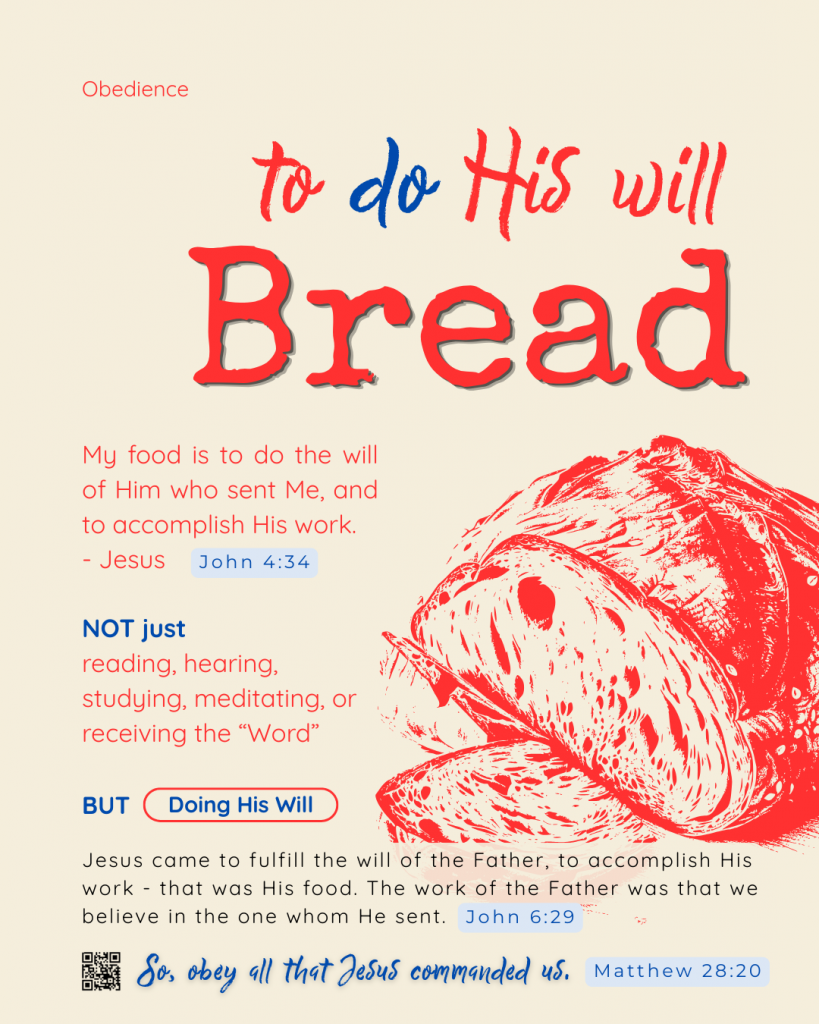
1. Doing is food!

In the first of these illustrations Jesus, emphasised this truth powerfully, using the metaphor of food as His sustenance.

We read in John 4:34-38, Jesus said to them, “My food is to do the will of Him who sent Me, and to accomplish His work. Do you not say, ‘There are still four months, and then comes the harvest’? Behold, I tell you, raise your eyes and observe the fields, that they are white for harvest. Already the one who reaps is receiving wages and is gathering fruit for eternal life, so that the one who sows and the one who reaps may rejoice together. For in this case the saying is true: ‘One sows and another reaps.’ I sent you to reap that for which you have not laboured; others have laboured, and you have come into their labor.” 

Jesus found His deepest satisfaction not in physical bread, but in fulfilling the Father’s mission.  Note the detail, – To do His will and finish the work He was entrusted with. Sowing, and reaping for the Kingdom of God, that was part of the task set before Him. Note again here, Jesus said, “I sent you to reap”! The task is again emphasised. Obedience brings eternal fruit and shared joy between sowers and reapers. True spirituality fuels active participation in God’s harvest today.

2. The forgetful man in the mirror.

James 1:22-25 reads, “But prove yourselves doers of the word, and not just hearers who deceive themselves. For if anyone is a hearer of the word, and not a doer, he is like a man who looks at his natural face in a mirror; for once he has looked at himself, and gone away, he has immediately forgotten, what kind of person, he was. But one, who has looked intently at the perfect law, the law of freedom, and has continued in it, not having become a forgetful hearer but an active doer, this person will be blessed, in what he does.”

Mere hearing, leads to self-deception. But intentional, ongoing obedience, to God’s Word, brings blessing, and true transformation.

3. The Wise Build on Solid Foundation.

Matthew 7:24-27 reads, “Therefore, everyone who hears these words of Mine, and acts on them, will be like a wise man who built his house on the rock. And the rain fell and the floods came, and the winds blew and slammed against that house; and yet it did not fall, for it had been founded, on the rock. But everyone, who hears these words of Mine, and does not act on them, will be like a foolish man who built his house on the sand. And the rain fell and the floods came, and the winds blew and slammed against that house; and it fell, and its collapse, was great.”

Storms reveal the foundation. Obedience anchors us in Christ.

4. Obeying His commands, is evidence, of knowing God.

1 John 2:3-6 reads,“By this, we know, that we have come to know Him, if, we keep His commandments. The one who says, ‘I have come to know Him,’ and does not keep His commandments, is a liar, and the truth is not in him; but whoever follows His word, in him the love of God has truly been perfected. By this we know, that we are in Him: the one who says that he remains in Him, ought himself also to walk just as He walked.”

Claiming to know God without obedience is self-deception. Walking as Jesus walked is the proof of a genuine relationship. Walk, just as He walked, should be echoing in our lives.

5. Loving God, means obeying His commands.

John 14:21 reads,“The one who has My commandments and keeps them is the one who loves Me; and the one who loves Me will be loved by My Father, and I will love him and will reveal Myself to him.”

Obedience is the language of love toward God. It invites deeper intimacy and greater revelation of Christ. Yes, don’t miss this. When we love Him, we obey Him, and when we do that, we see more of Him, and grow in intimacy, with Him.

6. Obedience brings forth fruit.

In John 15:5 we read, “I am the vine, you are the branches; the one who remains in Me, and I in him bears much fruit, for apart from Me you can do nothing.” What is remaining in Him, mean? The answer, lies in a few verses further down, in verse 10 which goes like this, “ If you,, keep My commandments, you will remain in My love; just as I have kept, My Father’s commandments, and remain in His love. 

It is His will that we bear much fruit. This comes by obedience, and no other way. Without obedience you can do nothing of value in His kingdom. Nothing at all!

7. Not Everyone, Who Says “Lord, Lord”, Will Enter.

In Matthew 7:21-23 we read. “Not everyone who says to Me, ‘Lord, Lord,’ will enter the kingdom of heaven, but the one, who does the will, of My Father who is in heaven will enter. Many, will say to Me, on that day, ‘Lord, Lord, did we not prophesy, in Your name, and in Your name, cast out demons, and in Your name perform many miracles?’ And then I will declare to them, ‘I never knew you; depart from Me, you who practice lawlessness.” 

Note, practice lawlessness, or practice sin, or practice disobedience. It is a life-style of disobedience. Seen again in 1John 3:4,6,8,&9.

Impressive works, without an obedient relationship, to the Father, mean nothing, in the end. Don’t be deceived by performance or manifestations. They are not proof for a living, loving, growing, 2-way relationship with God. God needs to know, and recognise His own children, His sheep. His sheep, hear His voice, and these are the ones He knows and saves.

Heavenly Father, help us not only to hear Your Word, but to adhere to it with wholehearted obedience. Let Your will be our food, Your commands our delight, and our lives unshakeable testimonies of genuine faith. Reveal Yourself, to us as we keep Your Word. In Jesus’ name, Amen.

Friend, may this reflection, encourage you today to move from simply hearing, to active, joyful adherence, for the glory of God, and the blessing of your life.

Hearing and adhering – the two strands of the same twine.

Spotify channel!

Hello everyone. We are pleased to let you know our new Spotify channel is now online. Please follow to get updates of new podcasts.

In everything we pray that this would be helpful in life’s journey. Best and warm wishes.

SPOTIFY CHANNEL

What is my food?

My food is to do the will of Him who sent Me. (John 4:34),
Blessed are those who hunger and thirst for righteousness. (Matthew 5:6)

As human beings, we all understand appetite. Hunger and thirst are universal instincts. When we are hungry, everything else becomes secondary. We look for food. We pursue it. And when we finally eat, there is satisfaction, relief, even pleasure, especially when the food is good. At times, hunger becomes so strong that we pause everything else until it is satisfied. There is a kind of urgency, even desperation, to meet that need.

Now consider our Christian walk. We often hear believers say, “I feed on the Word of God.” They speak of waking up early, reading Scripture, memorising it, meditating on it, and drawing strength from it. This is deeply commendable. A genuine hunger for God’s Word is a gift, and not every Christian experiences it the same way. Jesus Himself constantly referred to Scripture. He quoted it, explained it, and used it to correct misunderstanding. Even at a young age, He was engaging with scholars in the temple.

There is no doubt that He knew the Word intimately. But when Jesus described His food, He did not say it was the Word of God. He said His food was doing the will of God. That should stop us! It suggests that His hunger did not end with knowing the Word. It went beyond reading, beyond studying, beyond teaching. His deepest satisfaction came from obeying it, living it out, fulfilling it in real life. And that is where the challenge lies. We can read about forgiveness. We can study it, discuss it, even preach it. We can move others emotionally, bring them to tears, and feel a sense of spiritual fulfilment from that experience. But ask yourself honestly, when you read about forgiveness, what is your first instinct? Do you think about applying it? Do you immediately recall a person you need to forgive? Do you feel an urgency to act? Or do you simply move on, content with understanding it? If physical hunger worked the same way, we would read a recipe and feel satisfied without eating. But that is not how hunger works. Hunger demands action that leads to fulfilment.

Yet spiritually, we often stop at consumption without obedience. We engage in discussions, debates, and reflections that give us a spiritual “high.” We feel satisfied because we have understood something, shared something, or even impacted others. But Jesus points to a deeper level of satisfaction. His joy, His fulfilment, His “food”, was found in obedience. He found it delicious to do the will of the Father. He found it satisfying to obey.

Now think about the Lord’s Prayer: “Give us this day our daily bread.” We often understand this as God meeting our physical needs. And rightly so. But it also invites a deeper reflection—what is the daily bread of our spirit? It is not just hearing the Word. It is not just meditating on the Word. It is living it. Jesus once stood in the synagogue and declared, “Today this Scripture is fulfilled in your hearing.” (Luke 4:21) What if we lived like that? What if each day, after reading God’s Word, we could say: “Today, this was fulfilled in my life.” That is where true satisfaction lies. Not just in knowing the Word, but in seeing it take flesh in our actions and in our life.

So yes, let us love the Word of God. Let us read it, meditate on it, and treasure it. It brings comfort, gives direction, lifts our hearts, and fills us with peace. But let us not stop there. Let us move from consumption to obedience. From understanding to action. From hearing to doing. Let us hunger not only for the Word, but for the will of God. And let that hunger drive us until His Word is fulfilled in our lives, daily.

Lord, give me a deeper hunger, not just for Your Word, but for Your will. Forgive me for the times I have been satisfied with understanding without obedience. Stir in me a holy urgency to live out what I read. Let Your Word not stop at my mind but reach my actions. Teach me to find true satisfaction in obeying You. May Your Word be fulfilled in my life each day. May your will be done, today, in me, in Jesus’ name, amen.

You have not truly fed on the Word of God until you have obeyed it.

Beatitudes – Profit in Poverty.E1

You might think, “how can one profit from poverty?”. That is ridiculous. But that my friend is precisely, the beauty, about the kingdom of God. Listen to Jesus:

“And He raised His eyes toward His disciples and began saying, ‘Blessed are you who are poor, for yours is the kingdom of God.’” Luke 6:20

This is the opening statement of one of the most profound discourses ever given. Remarkably, Jesus does not begin with themes of earthly glory, wealth, power, or prestige. He begins with poverty. Why? Because there is a unique beauty in recognising our lack before God. Deficiency, inadequacy, humility, brokenness, desperation, and need, place us in a position where we are ready to receive from Him. Poverty, in this sense, becomes a doorway to divine blessing.

The question naturally arises: Is Jesus speaking of physical poverty, spiritual poverty, or both? The whole counsel of God suggests that both are in view. Matthew emphasises spiritual poverty, while Luke’s account appears to include those who are materially poor as well.

Matthew 5:3.“Blessed are the poor in spirit, for theirs is the kingdom of heaven.”
Matthew 11:5. “The blind receive sight and the lame walk, the people with leprosy are cleansed and the deaf hear, the dead are raised up, and the poor have the gospel preached to them.”
Luke 7:22. “Go and report to John what you have seen and heard: people who were blind receive sight, people who limped walk, people with leprosy are cleansed and people who were deaf hear, dead people are raised up, and people who are poor have the gospel preached to them.”

Throughout His ministry, Jesus showed special concern for those who recognised their need. Whether their poverty was material, spiritual, or both, they were often the ones most ready to receive His message.

The Apostle Paul also speaks of a remarkable paradox:

2 Corinthians 6:10. “As sorrowful yet always rejoicing, as poor yet making many rich, as having nothing and yet possessing all things.”

Paul’s words suggest that outward poverty does not prevent inward abundance. Those who may possess little in this world can nevertheless enrich others through the spiritual treasures they have received in Christ. It is therefore worthwhile to consider why such a state is viewed so favourably by God.

Firstly, poverty of spirit: reflects faith. Faith comes to God empty-handed, acknowledging dependence upon Him. Now don’t miss this. Faith pleases God!

Hebrews 11:1-2. “Now faith is the certainty of things hoped for, a proof of things not seen. For by it the people of old gained approval.”
Hebrews 11:6. “And without faith it is impossible to please Him, for the one who comes to God must believe that He exists, and that He proves to be One who rewards those who seek Him.”

A heart that recognises its need is often a heart prepared to trust God. It comes saying, “Lord, I cannot do this without You. I need Your strength, Your wisdom, Your grace, and Your help.”

Second, poverty of spirit: produces humility. It acknowledges our dependence upon God and our inability to save or sustain ourselves apart from Him. Such humility is precious in His sight because it agrees with His verdict that all have sinned and fallen short of His glory. Brokenness creates an awareness of our need. Pride, by contrast, leans toward self-sufficiency and self-reliance, resisting the very help God freely offers.

Scripture also teaches that godly sorrow has great value:

2 Corinthians 7:10 “For the sorrow that is according to the will of God produces a repentance without regret, leading to salvation, but the sorrow of the world produces death.”. 

Only the broken, truly understand their need for forgiveness, grace, and mercy. God has designed us to live in fellowship with Him, to rest in Him, trust Him, commune with Him, confide in Him, and cast our burdens upon Him. Poverty of spirit brings us back to that place of repentance and dependence restoring fellowship with Him.

Thirdly, the brokenhearted: discover God’s proximity.

Psalm 34:18 “The LORD is near to the brokenhearted and saves those who are crushed in spirit.” 

When suffering strips away our illusions of self-sufficiency, we often become more aware of God’s presence and help. The position we are in draws us to a closer and intimate walk with Him, in a way that would not be possible otherwise. That is His methodology.

Fourthly poverty makes room: for the display of His glory. When we are empty, He can fill us. When we are weak, His strength is perfected. Our mourning turns to dancing. Surrender invites His glory. What appears to be weakness becomes the stage upon which His strength is displayed.

Poverty of spirit is not an end in itself. God meets us in our need and fills us with His grace. Mourning gives way to joy, weakness gives way to strength, and despair gives way to hope. Yet this dependence is not merely a one-time experience; it becomes the daily posture of the believer. Every day we come afresh to the Lord, and every day His mercies are new.

Finally, with poverty comes promise: to the poor

Luke 6:20 “Blessed are you who are poor, for yours is the kingdom of God.” 

The reward is not merely relief from poverty but participation in God’s kingdom, His rule, His reign, and His gracious authority over our lives.

Romans 14:17 “For the kingdom of God is not eating and drinking, but righteousness and peace and joy in the Holy Spirit.” 
James 2:5 Listen, my beloved brothers and sisters: did God not choose the poor of this world to be rich in faith and heirs of the kingdom which He promised to those who love Him?

This kingdom is experienced most fully by those who recognise their need for God. The poor in spirit discover that what they lack in themselves is abundantly supplied in Him.

True blessedness is not found in self-sufficiency but in His sufficiency. The one who comes empty-handed to Christ finds a treasure greater than all the riches of this world, the kingdom of God itself!

O mighty One, enthroned above,

I long to remain in this holy place,
The tender ground of godly sorrow,
Where my broken heart beholds Your face.

Each day I come with thankful hands,
Through gates flung wide by sovereign grace.
Into Your courts I lift my praise
And bow within Your sacred space.

Teach me to know You more deeply,
To enjoy You more fully,
To walk with You more faithfully,
And to trust You more completely.

Keep me humble before You,
Dependent upon Your strength,
Rich in Your grace,
And satisfied in Your presence.

Until that day when faith becomes sight
And I behold You face to face forevermore.

Amen.

The happiest soul is not the one that needs nothing, but the one that has learnt it needs Christ for everything.