God’s purpose

“You are not setting your mind on God’s purposes, but on man’s.” Jesus said to Peter in Matthew 16:23

When Jesus declared that the Son of Man must suffer, must go to Jerusalem, and must be killed, Peter stepped in to stop Him. What sounded like loyalty was actually resistance. What felt loving was, in truth, rebellion. Peter did not oppose Jesus out of hatred but out of misplaced affection. He loved Jesus, but he hated the path. He wanted the Kingdom without the cross that gives birth to it. But small is the gate and narrow the road that leads to life. (Matt 7:13, NIV).

Jesus’ response was not gentle. “Get behind Me, Satan.” “You are not setting your mind on God’s purposes, but on man’s.” That rebuke exposes something deeply uncomfortable: Peter was sincere but sincerely wrong, emotionally devoted but spiritually misaligned, close to Jesus yet opposing the will of God.

Six days later Peter stands on another mountain, this time not facing suffering but glory; the transfiguration, radiance, Moses, Elijah, heaven touching earth, and Peter speaks again. “Lord, it is good for us to be here. Let us stay. Let us build tents. Let us settle.” The irony cuts deep. Earlier Peter tried to prevent the suffering; now he tries to preserve the comfort. Two examples, same mindset. Jesus does not rebuke him this time, but could have said the same thing,’ you are not setting your mind on God’s purposes, but on man’s’. God never intended the mountain to be a destination. It was a revelation, not a residence. The glory was meant to strengthen them for obedience, not distract them from it. God’s purpose was never the mountain; it was the cross waiting below.

Jesus was possessed with purpose, and purpose shaped His perspective. Romans 12 tells us that transformation comes through the renewing of the mind so that we may discern the will of God, and Jesus lived this perfectly. His ministry was not emotional, impulsive, or reactionary; it was resolute. He knew where He was going and He refused to be distracted by comfort, fear, or spiritual spectacle.

None of us will ever carry a purpose as cosmic as Christ’s, but that does not mean our days are purposeless. At the very least every Christian shares this calling: to glorify God, to live a life that pleases Him, to walk daily in victory over sin, to witness the steady, sometimes painful transforming work of the Holy Spirit changing us from one degree of glory to another. Purpose is not always dramatic, but it is always directional. Once purpose is clear, perspective follows, and when perspective is right, excuses collapse. Perspective reshapes choices, governs reactions, dictates how we speak at home, how we behave at work, how we respond to suffering, and how we handle moments of pleasure and glory. Without purpose we chase comfort, without perspective we resist suffering and idolise experiences, we rebuke the cross and cling to the mountain, and then we wonder why we are spiritually stagnant. The problem is not lack of revelation; it is misaligned minds. Jesus’ words still stand: “You are not setting your mind on God’s purposes, but on man’s.” That sentence should haunt us until it renews and realigns our mind.

Lord, search me and expose every place where my mind is set on comfort instead of calling, on experience instead of obedience, on glory instead of the cross. Strip away false spirituality, misplaced affection, and every subtle resistance to Your will that I have dressed up as love. Renew my mind until I no longer interpret life through fear, ease, or emotion, but through Your eternal purpose. Give me the courage to follow You when the gate is small and the road is narrow. When the path leads downward rather than upward. To embrace obedience when it costs me, and to choose Your will over my preferences. Align my perspective with Your purpose, that my life would not be impressive, but submissive. In Jesus’ name, amen.

What the dogs understood

Matthew 15:21–28

Jesus withdraws into the region of Tyre and Sidon, Gentile territory. Outsider land. And from that place comes a woman with no pedigree, no covenant, no invitation. A Canaanite woman. She cries out, desperate, loud, unfiltered: “Have mercy on me, Lord, Son of David!”

And Jesus answers her with silence. No reassurance. No explanation. No religious courtesy. ‘How rude’ one could have thought!

The disciples are irritated. “Send her away.” Jesus speaks the truth without padding: “I was sent only to the lost sheep of Israel.” She does not leave. She bows lower. Then comes the statement that would have sent most of us home offended, wounded, and spiritually offended for life: “It is not right to take the children’s bread and throw it to the dogs.”

And here is the dividing line between offended pride (or we dress it up as self-respect) and desperate faith. She does not argue. She does not reframe the truth to protect her dignity. She does not demand her rights. She accepts reality and reaches anyway. “Yes, Lord. I know my place. But even the dogs live because crumbs fall from the table.” This woman had no reputation to protect. No seat to secure. No image to manage. Only hunger. Dogs don’t care about the table arrangement. They don’t care who is seated where. They don’t care who is speaking. They care about survival. They believe the table is full. They believe the abundance is real. They believe enough will fall to live. She ‘believed that He is, and that He is a rewarder of those who diligently seek Him (Heb 11:6, NKJV). And Jesus stops everything. “O woman, great is your faith.” Not great theology. Not great position. Great faith. Her daughter is healed instantly.

Now pause and let this confront us. She was an outsider begging for crumbs. We are sons and daughters invited to the table. She had no covenant.  We have the promise; New Covenant sealed in blood. She stood outside the house. God who raised Christ from the dead, lives in us. The power that opened graves abides in us. The fullness of the table is ours. And yet, how many of us reject the table and actually live like dogs! What a tragedy. She believed crumbs were enough to change her life. We doubt the feast is enough to transform ours. We sit at the table and live hungry. Empty. Powerless. Defeated. Still enslaved to sin. Still shaped by the flesh. Still spiritually malnourished. Not because the table is empty. Not because the invitation was unclear. But because we do not believe.

What a tragedy: Dogs fought for crumbs—and were satisfied. Sons refuse the feast—and go home starving. The table is full. The Spirit is present. The power is available. The question is no longer “Is there enough?” The question is “Do you believe?”. We are invited and live powerless. We are filled and still choose deprivation. The problem is not access. The problem is appetite. She came desperate. We come casual. She would not leave without an answer. We leave unchanged and call it Christianity.

Jesus did not commend her status. He commended her faith-born hunger. And the question hangs in the air for us: Will we live like dogs grateful for crumbs (even that would be commendable), or like sons who finally believe the table is ours?

Lord, forgive us for living beneath our inheritance. Forgive us for sitting at Your table and still choosing hunger. Awaken in us a holy desperation—not for reputation, but for transformation. Teach us to believe again. Let us not leave Your presence empty when fullness is offered. In Jesus’ name, Amen.

Take your pump

Matthew 14:13–16 · 2 Corinthians 10:3–5

John the Baptist was beheaded. Jesus Himself said there was no one born of women greater than John. He was righteous. He was faithful. And yet he was imprisoned, silenced, and murdered, not on a battlefield, but in a prison cell, at the request of a young dancer, as part of a calculated attempt to hide sin within a king’s household. John was not just a prophet. He was Jesus’ family.

And when Jesus heard the news, Scripture says He withdrew to a secluded place. Most of us instinctively know why. Jesus withdrew to pray. This was not avoidance. This was not weakness. This was wisdom. Jesus often withdrew to lonely places to pray, but this moment was different. This was grief. This was injustice. This was personal. And if Jesus was fully human, as Scripture declares, then this moment would have carried a storm of emotions: sorrow, anger, confusion, even questions that pressed hard against the soul. The battle was not external. The battle was in the mind.

And Jesus knew something we often forget: Battles of the mind must be fought before God, not before people.

I suffer from asthma. It came later in life. There are triggers, laughter, exertion, sudden strain. My wife often checks “take your pump with you “.  When an attack comes, I don’t argue with it. I don’t power through it. I withdraw, take out my blue pump, take a deep breath, pause and only when my breathing is restored do I return to what I was doing. The relief is immediate. Order is restored in my body. I can function again.

Jesus models the same principle for prayer. When the pressure surged, when the emotions threatened to cloud the mind and disturb the heart, He withdrew. He knew that “the weapons of our warfare are not of the flesh, but divinely powerful for the destruction of strongholds.” He took every thought captive to the obedience of God before it could take Him captive. Prayer was not optional, it was oxygen.

After that time alone with the Father, Scripture tells us something remarkable: When Jesus came back, He saw the crowd and He felt compassion. After prayer, Jesus felt the correct emotion and made the correct decision. The disciples wanted to send the people away. After prayer, Jesus fed them. Prayer reset His heart. Prayer recalibrated His emotions. Prayer realigned Him with the will of God. Prayer was medicine and treatment for the soul. It is essential.

We too have such “asthmatic attacks” of the flesh. Surges of anger. Waves of discouragement. Impulses of lust. Floods of self-pity, pride, resentment, fear. If left untreated, these attacks will drag us away. If indulged, they will end in sin. The problem is not that the attack comes. The problem is when we refuse to take the medicine, prayer. Instead of praying, we react. Instead of withdrawing, we vent.

Instead of kneeling, we justify. And then we wonder how we fell.

Like chronic illness, the flesh may not be cured overnight, but it can be managed. Scripture does not just diagnose the condition; it provides the treatment. Prayer is not a religious activity, it is survival. So, take your pump with you. Withdraw early. Pray honestly. Bring thoughts and emotions captive before they become actions. Because when we return from prayer, we return able to feel rightly, decide wisely, and act obediently. Prayer is the reset button that restores sanity to the soul.

Father God, teach us to withdraw before we react. Forgive us for fighting spiritual battles with carnal strength. When emotions rise and thoughts rage, draw us into Your presence. Train us to take every thought captive before it takes us captive. Restore our breath through prayer. Reset our hearts through Your Spirit. And send us back into life aligned with Your will, Your compassion, and Your wisdom. In Jesus’ name, Amen.

Walking in Fear

Matthew 13:40–43, 47–51. Jesus said: “As the weeds are pulled up and burned in the fire, so it will be at the end of the age… They will throw them into the blazing furnace, where there will be weeping and gnashing of teeth.” And then again, in the very same chapter: “The angels will come and separate the wicked from the righteous and throw them into the blazing furnace…”

Twice. Two parables. Same warning. Same outcome. And after saying it all, Jesus asked a chilling question: “Have you understood all these things?” That is what you ask when something truly matters. Somehow, we do not like to think about God and judgment. We love to talk about heaven, but we are uncomfortable talking about hell. The moment a conversation drifts in that direction, we quickly redirect it: “God is a good God. God is loving. God doesn’t want to punish anyone.” That is true. But it is also true that Jesus spoke about hell—clearly, deliberately, and repeatedly. He did not describe it vaguely. He called it a blazing furnace. And He made sure His listeners had heard and understood. Why? Because perspective saves us. For me, the reality of judgment is strangely advantageous. It recalibrates life. It shrinks trivial things. It exposes how foolish many of our conflicts are.

How often do we fight at home over nothing? Raised voices. Short tempers. Harsh words. Long silences. Pride digging in its heels. Making peace becomes harder than winning the argument. We wait for the other person to move first. “Sorry” gets stuck in our throat. And when the Spirit nudges us, we resist—because our pride feels justified. But perspective changes everything.

I once knew someone who was overwhelmed at work—emotional, stressed, known by others as dramatic. Her partner, a paramedic, was called to what began as a simple incident. It turned into a six-vehicle crash. A police officer and the paramedic were seriously injured when an intoxicated driver ploughed into their stationary vehicles. Her partner escaped with only minor injuries. The next time she came to work, she was almost uncontrollably joyful. Nothing at work had changed. The problems were still there. But she had perspective. Suddenly, what once felt unbearable no longer mattered.

This is what the fear of God does. When we remember that there is a blazing furnace, suddenly saying “I’m sorry” becomes easy. Making the first move becomes joyful. Letting go of being right becomes wise. Like Paul said, we do not want to miss out. We can argue endlessly about who is right and who is wrong. Or we can humble ourselves, please God, and rule out—even in our own hearts—the licks of the blazing furnace.

This is not a feel-good message. But it is a necessary one. Somewhere along the way, Christians have stopped walking in fear. Yes—this fear includes love, reverence, respect, and awe. But it is also plain fear as we commonly know it. The Old Testament saints knew God as a consuming fire—and they lived accordingly. They did not trivialise obedience. They did not treat repentance casually. They did not presume on grace. Jesus himself said “But I will show you whom you should fear: Fear him who, after your body has been killed, has authority to throw you into hell. Yes, I tell you, fear him”.

Walking in the fear of the Lord does not make us miserable. It makes us wise. It keeps us soft-hearted. It keeps eternity in view and it helps us live today like tomorrow really matters.

Holy God, forgive us for growing casual with things You take seriously. Forgive us for trivialising sin, postponing repentance, and resisting humility. Restore in us the fear of the Lord—not a fear that drives us away, but a fear that anchors us in truth. Give us eternal perspective so that pride loses its grip and obedience becomes our joy. Teach us to walk carefully, love deeply, forgive quickly, and live wisely—knowing that You are holy, just, and worthy of our awe. In Jesus’ name, Amen.

 Holiness or Hypocrisy

Blessed are those who hunger and thirst for righteousness, for they will be satisfied. Mathew 5:6 ( NASB)

Lord, we must be honest before You: many of us want the appearance of holiness more than the nature of it. It is striking that many Christian leaders are not undone by smoking, drugs, or alcoholism. More often, they are exposed by illicit affairs or long confessions of bondage to pornography. Why? Because these are hidden sins. Sins that allow a man to remain entertained in secret while still maintaining a public ministry. Sins that let the sermon survive while the soul decays.

Mediocrity sets in. Familiarity replaces fear. Routine replaces reverence. Performance replaces purity. Holiness becomes something we play, not something we are. God asks us to “Be holy”, not do holy things (1 Peter 1:16). We learn how to switch it on for Sunday services, cell groups, Bible studies, and Christian gatherings. And alongside that public life, a private life of immorality and self-indulgence quietly continues. Two lives. One reputation. One hidden reality. At that point, we must ask an uncomfortable question:
Did we ever want God’s nature, or did we only want the reputation of having it?
Jesus said, “Blessed are those who hunger and thirst for righteousness, for they shall be filled.” (Matthew 5:6). He did not say, “Blessed are those who want to be known as righteous.”

The desire to be seen, admired, and applauded is not new. It is woven into the old man—the flesh. Scripture calls it the boastful pride of life(1 John 2:16). And this battle is daily: Will we live before men, or will we live before God? Hidden sin may survive before people, but it never survives before God. And when hidden sin is tolerated, it exposes something devastating: we were never pursuing holiness at all. We were simply using the church—its language, its platform, its culture—to chase the same thing the world chases: reputation and public approval.

Let us repent. Let us return to the words of Jesus and sit with them slowly: “Hunger and thirst for righteousness.” Not recognition. Not influence. Not visibility. Righteousness!
This must become our desire, our passion, our pursuit—every moment we live. Jesus Himself is our pattern. For the first thirty years of His life, He had almost no reputation at all. No platform. No crowds. No applause. He was not seeking to be known—He was seeking to please the Father.

And that is the call before us now. Not to protect an image. Not to polish a ministry.
But to cry out with honesty: “Lord, give us Your nature—even if it costs us our reputation.”
Because a righteousness that exists only before people is hypocrisy.
But righteousness that exists before God is Holiness.

Lord, We confess that we have often loved the praise of people more than the pleasure of Your presence. We have guarded our reputation while neglecting our hearts. Forgive us for tolerating hidden sin and calling it weakness instead of calling it disobedience. Strip us of every false image we have built and clothe us instead with the righteousness of Christ. Give us a holy hunger—not to be seen as righteous, but to truly become righteous. Search us, expose us, and transform us. We want Your nature, not a name. Your approval, not applause. Your holiness, not our image. In Jesus’ name, Amen.

My Hiding Place

I will not be afraid
For You are my hiding place-
A secure refuge, the safest space,
A shelter free from all condemnation,
A haven of unshaken confidence.

I will not fear,
For You are my hiding place.
No danger can draw near enough to harm;
I am safe, encircled by Your arms
Secure in You as in an impregnable fortress

I will not be found by the enemy,
For you are my hiding place.
I am hidden with Christ in You;
None who intend harm can see me through,
For I am concealed, O Lord, in You.

I will not be anxious,
For You are my hiding place.
None can disturb this perfect peace;
My confidence is in You-and You are my confidence;
My trust is in You-and You are my trust.

And more than this: 
You cover me with songs,
Songs of deliverance.
The Rock of ages, cleft for me,
Let me hide myself in Thee.

To download a pdf copy with a decorative sepia tone click here

When a Brother Falls

Today I heard that a widely respected Christian author and preacher, now 76 years old, a man who has spent almost a lifetime writing books that have blessed millions, has confessed to an affair that lasted eight years. This is not the first time we have heard such news. We remember others, public servants of God, who fell during the COVID period, some of whom are no longer alive to speak for themselves. And as the news broke, my mind did not rush to his sin. It drifted to our response.
 
What I witnessed
Within hours, clips flooded YouTube and social media; shock, disbelief, outrage.
“How could this happen?”. “How did he fall so far?”. Then came the predictable chorus: name-calling, public disqualification, mockery, speculation, exaggeration, ridicule, targeted humiliation; mostly from fellow Christians. The church did not pray.  It pounced. Like a pride of hungry lions on a wounded deer, we ripped and tore while he was still alive. We called it “discernment.” We called it “protecting the flock.” But what it often was, was self-righteous cruelty dressed in spiritual language. Yes, there will be consequences. He will step down from leadership. He will likely never be received the same way again. His future words will be filtered through suspicion. Friends will quietly distance themselves. His name, once spoken with respect, honour and gratitude, will now be spoken with shame and disgrace. In short, he will be rejected. And perhaps the most tragic part: he will feel condemned, not only by his own conscience, but by the very community that preaches forgiveness, mercy and grace. If not now, when else can we practice what we preach!.
 
Joseph’s Response
Consider Joseph. When he discovered that Mary was pregnant, the most natural conclusion was betrayal. He had every legal and cultural right to expose her. Public shaming would have been justified in the eyes of the law. But Joseph chose another way. He resolved to step back quietly. No spectacle. No naming and shaming. No moral theatre. His restraint was not weakness, it was righteousness. The only reason he acted at all was obedience to God, not a hunger to be proven righteous.
 
God’s Response
Now let us pause and look at God’s pattern, not ours. Scripture tells us of a man who lived long ago, a man God Himself called “a man after My own heart.” God lifted him from anonymity, from tending sheep, from running for his life, and seated him on a throne as king. That man abused his power. He took another man’s wife and arranged her husband’s death. He lived in deception for over a year, continuing his public duties as if nothing had happened. If ever there was a case for permanent disqualification, this was it. And yet, when confronted and broken in repentance, God did something amazing. He forgave him. Not only that, God allowed him to continue to write and minister. God published his prayers, poems, and songs, not in an obscure appendix, but at the very heart of Scripture. Thousands of years later, God did not introduce him primarily as “the adulterer” or “the murderer”. God remembered him as David and the ultimate honour; Jesus Himself was called the Son of David. This does not minimise David’s sin. It magnifies God’s mercy. God did not pretend the sin never happened, but He also refused to let sin have the final word. He always has the final word, in all things. He is God,…remember? Sovereign and supreme.
 
….And Now Us
How do we respond when someone else falls? Do we forward the news under the banner of “discernment” while spreading gossip? Do we disguise curiosity as concern?
Do we host prayer meetings and Bible studies that quietly feed on scandal; a hot coffee, a cold heart, a cynical mind and caustic remarks. We say, “He let us down.” But I ask, what promise did he ever make to you? We act betrayed, as if our faith was anchored in a man rather than in Christ. This is not a call to excuse sin. This is not a plea to ignore accountability. But it is a warning: that while we point out that he failed to guard his heart, we must guard our own hearts from becoming ‘Pharisaical’. “God, I thank you that I am not like other people—robbers, evildoers, adulterers—or even like this tax collector. I fast twice a week and give a tenth of all I get.” (Luke 18:9-14 NIV). Jesus says the tax collector went home justified,  while the religious man went home condemned.

A fallen preacher should cause fear, not fascination. Tears, not triumph. Self-examination, not self-exaltation. Because when a brother falls, the real question is not “How could he?” . That is between God and him.  

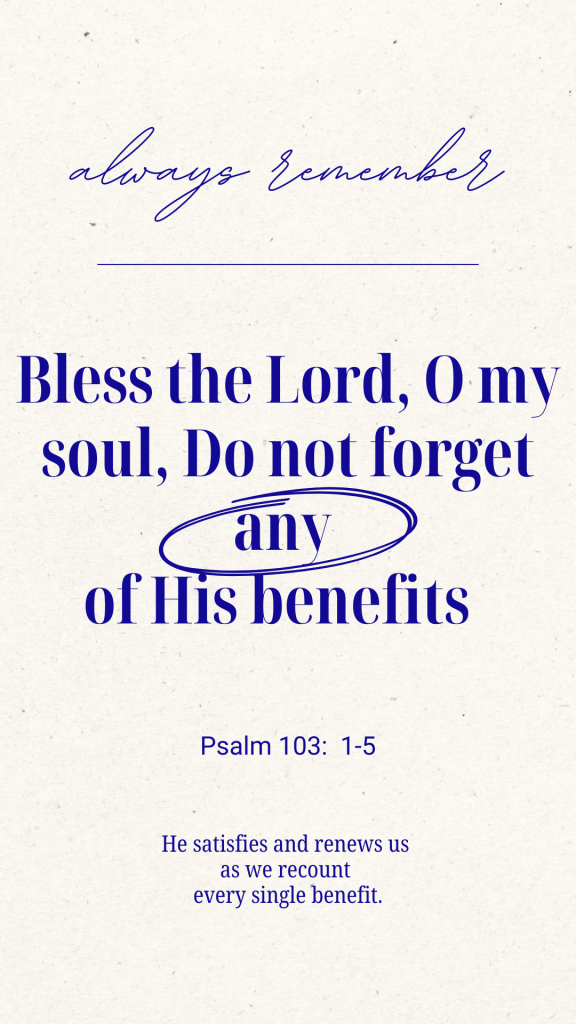
He satisfies me. Psalm103: 1-5

1 Bless the Lord, my soul,
And all that is within me, bless His holy name.
2 Bless the Lord, my soul,
And do not forget any of His benefits;
3 Who pardons all your guilt [iniquities],
Who heals all your diseases;
4 Who redeems your life from the pit,
Who crowns you with favour [steadfast love] and compassion [mercy];
5 Who satisfies your [desires] years with good things,
So that your youth is renewed like the eagle.
  • He pardons
  • He heals
  • He redeems
  • He crowns
  • He loves
  • He satisfies
  • He renews

He satisfies and renews us as we recount every single benefit; big and small.

Gethsemane before Golgotha

Keep watching and praying, so that you do not come into temptation; the spirit is willing, but the flesh is weak. Matthew 26:41(NASB)

Jesus said, “Pray lest you fall into temptation.” And unlike me, He lived it. To see this clearly, we only need to look at one moment: the Garden of Gethsemane. The garden gives us one of the clearest pictures of Jesus and us. It contrasts Jesus and us. Jesus is on His knees before the Father. The disciples, are on their backs. Jesus is weeping. They are sleeping. Jesus is watching. They are resting. Same night. Same pressure. Same warning. Different outcomes. That tells us everything about how temptation is faced.

Jesus did not stumble into temptation. He ran into prayer. This was not polite prayer. This was not quiet time. This was war. Luke tells us His sweat became like drops of blood.
Why such anguish? Not fear of pain. Not fear of death but fear of disobedience. Jesus was tempted, “Can I escape the cross?” So He kept praying , “Father, keep Me obedient.”

Here is the difference between Him and us: Jesus prayed for victory before temptation.

Jesus did not pray casually. He prayed honestly and earnestly. He prayed until the battle was won. Jesus prayed for victory before temptation. We often pray for forgiveness after failure. Jesus dug His well before He was thirsty. We dig ours after we are dry, desperate and ashamed.

And Scripture says He prayed three times. Why? Because prayer was not a checkbox. Prayer was not symbolic. Prayer was how obedience was settled. He prayed until His will was aligned. He prayed until heaven ruled His flesh. He crucified His flesh (Gal 5:24) before the Romans crucified him. He prayed until He was ready. And then He said something astonishing: “The hour has come.” How could He say that? Because the battle was already won. That is why later, before Pilate, before Caiaphas, before mockery, slander, and humiliation, He stood silent. No panic. No compromise. No collapse. Gethsemane made Calvary possible.

And then Jesus turned to the disciples and asked a question that still echoes today : “Could you not watch with Me for one hour?” That was not a rebuke only. It was a revelation. Because the disciples did not fail in the courtyard, they failed in the garden. Peter did not fall in the courtyard but fell when he slept instead of praying. And we are no different. We want strength without struggle. Victory without vigilance. Power without prayer.

But it does not work that way. Jesus is not asking us today for sympathy. He is asking for battle in prayer. Pray before you fall. Watch before you weaken. Settle obedience on your knees, not in regret. Because the battle is never first lost in public. It is always lost in private.

Are we willing to pray desperately until obedience is settled?

If we keep sleeping, we will keep falling. If we keep praying after the fall, we will keep repeating the cycle. But if we learn to pray like Jesus prayed, earnestly and desperately, we will stand where we once collapsed. Victory is not won in the moment of temptation. It is won in prayer before temptation ever comes.

Lord Jesus, Forgive us for sleeping where You prayed, and resting where You wrestled. Teach us to pray before the battle, not just repent after the fall. Give us hearts that fear disobedience more than discomfort. Train us to watch, to endure, and to win our battles on our knees. Make us followers not just of Your cross, but of Your prayer life. Amen.

Quote

Helper for holiness, NOT hype

If you love Me, keep My commandments. And I will ask the Father, and He will give you another Helper…(John 14:15–16 NKJV)

Jesus gives a command that feels humanly impossible, keep all My commandments, and before I can even protest, before I can say, “Lord, that’s too hard,” He answers the unspoken fear in my heart: I will give you a Helper. That is the mark of a loving Saviour. He does not wait for me to cry out; He anticipates my weakness.

It is important to notice how Jesus first introduced the Holy Spirit. He did not present Him in the ‘The Acts of the apostles’ amid excitement, spectacle, or dramatic manifestations, but in the quiet context of humble obedience. If I truly grasped this, much confusion would simply fall away. So often, I am tempted to think that the evidence of the Holy Spirit is outward; falling to the floor, laughing, crying, intense emotions, dramatic moments. But it does not take much for a person to laugh. Anyone can cry. Even demon-possessed people can convulse. None of these things define a Spirit-filled life.

So what is He a Helper for? What exactly is He helping us to do? Not to create a show.
Not to stir emotions. Not to draw attention. But to do the hardest thing of all: to live like Jesus. Many young Christians see these outward displays and quietly conclude that something is missing in them. They spend a lifetime feeling inadequate before God, measuring their spirituality by experiences rather than by obedience, love, and faithfulness. Jesus introduced the Holy Spirit not as a performer on a stage, but as a Helper; One who empowers us to obey, to love, and to walk faithfully with God. The true evidence of the Spirit is not how dramatically we respond in a moment, but how consistently we live in surrender.

Remember, God was pleased with Jesus before He began His public ministry. The Father was pleased with His private surrender, His hidden obedience, His quiet submission. Someone once said, “To err is human; to forgive is superhuman.” That is profoundly true. I do not need supernatural power to get emotional;  need it to forgive. I do not need divine help to feel something, I need it to put away bitterness, pride, lust, anger, resentment, jealousy, and every hidden sin that causes the misery and malady of my soul.

I do not need the Holy Spirit for hype. I need Him for holiness.

That Helper is the Holy Spirit, the Spirit of Truth. Not the spirit of performance, but the Spirit of Truth, who empowers me to obey the words of Jesus when my flesh resists. So, I choose to stop asking for ‘signs’ meant to impress others and start asking for ‘strength’ that transforms me. I choose to stop chasing feelings and start chasing obedience.

Father, forgive me for the times I have desired experience over obedience and emotion over transformation. Thank You for giving me the Holy Spirit, not to entertain me or others but to empower me to live like Jesus. Teach me to rely on Him daily to obey Your Word, crucify my flesh, and walk in truth. Give me strength for holiness, not hunger for hype. In Jesus’ name, Amen.