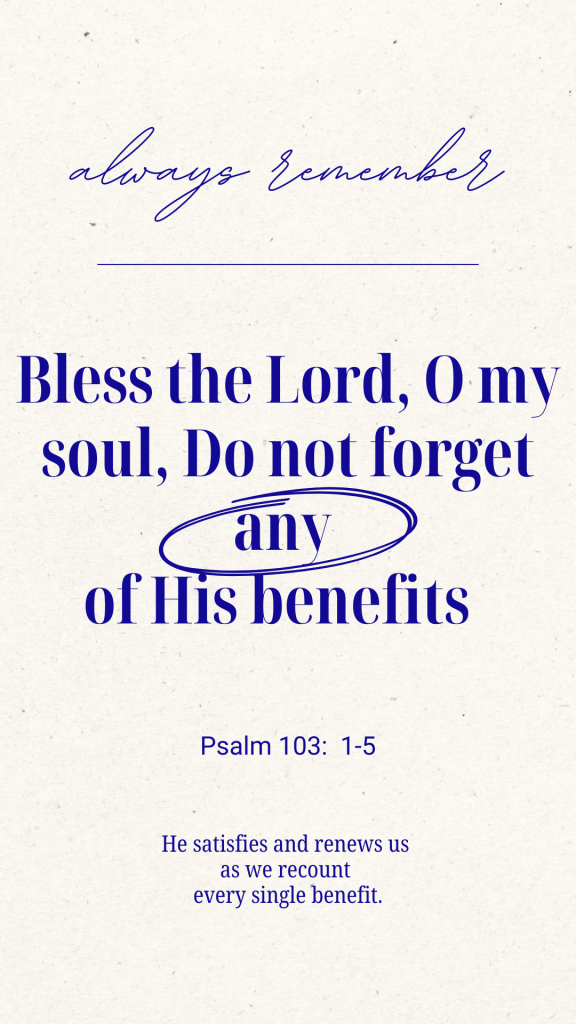
He satisfies me. Psalm103: 1-5

1 Bless the Lord, my soul,
And all that is within me, bless His holy name.
2 Bless the Lord, my soul,
And do not forget any of His benefits;
3 Who pardons all your guilt [iniquities],
Who heals all your diseases;
4 Who redeems your life from the pit,
Who crowns you with favour [steadfast love] and compassion [mercy];
5 Who satisfies your [desires] years with good things,
So that your youth is renewed like the eagle.
  • He pardons
  • He heals
  • He redeems
  • He crowns
  • He loves
  • He satisfies
  • He renews

He satisfies and renews us as we recount every single benefit; big and small.

Gethsemane before Golgotha

Keep watching and praying, so that you do not come into temptation; the spirit is willing, but the flesh is weak. Matthew 26:41(NASB)

Jesus said, “Pray lest you fall into temptation.” And unlike me, He lived it. To see this clearly, we only need to look at one moment: the Garden of Gethsemane. The garden gives us one of the clearest pictures of Jesus and us. It contrasts Jesus and us. Jesus is on His knees before the Father. The disciples, are on their backs. Jesus is weeping. They are sleeping. Jesus is watching. They are resting. Same night. Same pressure. Same warning. Different outcomes. That tells us everything about how temptation is faced.

Jesus did not stumble into temptation. He ran into prayer. This was not polite prayer. This was not quiet time. This was war. Luke tells us His sweat became like drops of blood.
Why such anguish? Not fear of pain. Not fear of death but fear of disobedience. Jesus was tempted, “Can I escape the cross?” So He kept praying , “Father, keep Me obedient.”

Here is the difference between Him and us: Jesus prayed for victory before temptation.

Jesus did not pray casually. He prayed honestly and earnestly. He prayed until the battle was won. Jesus prayed for victory before temptation. We often pray for forgiveness after failure. Jesus dug His well before He was thirsty. We dig ours after we are dry, desperate and ashamed.

And Scripture says He prayed three times. Why? Because prayer was not a checkbox. Prayer was not symbolic. Prayer was how obedience was settled. He prayed until His will was aligned. He prayed until heaven ruled His flesh. He crucified His flesh (Gal 5:24) before the Romans crucified him. He prayed until He was ready. And then He said something astonishing: “The hour has come.” How could He say that? Because the battle was already won. That is why later, before Pilate, before Caiaphas, before mockery, slander, and humiliation, He stood silent. No panic. No compromise. No collapse. Gethsemane made Calvary possible.

And then Jesus turned to the disciples and asked a question that still echoes today : “Could you not watch with Me for one hour?” That was not a rebuke only. It was a revelation. Because the disciples did not fail in the courtyard, they failed in the garden. Peter did not fall in the courtyard but fell when he slept instead of praying. And we are no different. We want strength without struggle. Victory without vigilance. Power without prayer.

But it does not work that way. Jesus is not asking us today for sympathy. He is asking for battle in prayer. Pray before you fall. Watch before you weaken. Settle obedience on your knees, not in regret. Because the battle is never first lost in public. It is always lost in private.

Are we willing to pray desperately until obedience is settled?

If we keep sleeping, we will keep falling. If we keep praying after the fall, we will keep repeating the cycle. But if we learn to pray like Jesus prayed, earnestly and desperately, we will stand where we once collapsed. Victory is not won in the moment of temptation. It is won in prayer before temptation ever comes.

Lord Jesus, Forgive us for sleeping where You prayed, and resting where You wrestled. Teach us to pray before the battle, not just repent after the fall. Give us hearts that fear disobedience more than discomfort. Train us to watch, to endure, and to win our battles on our knees. Make us followers not just of Your cross, but of Your prayer life. Amen.

Quote

Helper for holiness, NOT hype

If you love Me, keep My commandments. And I will ask the Father, and He will give you another Helper…(John 14:15–16 NKJV)

Jesus gives a command that feels humanly impossible, keep all My commandments, and before I can even protest, before I can say, “Lord, that’s too hard,” He answers the unspoken fear in my heart: I will give you a Helper. That is the mark of a loving Saviour. He does not wait for me to cry out; He anticipates my weakness.

It is important to notice how Jesus first introduced the Holy Spirit. He did not present Him in the ‘The Acts of the apostles’ amid excitement, spectacle, or dramatic manifestations, but in the quiet context of humble obedience. If I truly grasped this, much confusion would simply fall away. So often, I am tempted to think that the evidence of the Holy Spirit is outward; falling to the floor, laughing, crying, intense emotions, dramatic moments. But it does not take much for a person to laugh. Anyone can cry. Even demon-possessed people can convulse. None of these things define a Spirit-filled life.

So what is He a Helper for? What exactly is He helping us to do? Not to create a show.
Not to stir emotions. Not to draw attention. But to do the hardest thing of all: to live like Jesus. Many young Christians see these outward displays and quietly conclude that something is missing in them. They spend a lifetime feeling inadequate before God, measuring their spirituality by experiences rather than by obedience, love, and faithfulness. Jesus introduced the Holy Spirit not as a performer on a stage, but as a Helper; One who empowers us to obey, to love, and to walk faithfully with God. The true evidence of the Spirit is not how dramatically we respond in a moment, but how consistently we live in surrender.

Remember, God was pleased with Jesus before He began His public ministry. The Father was pleased with His private surrender, His hidden obedience, His quiet submission. Someone once said, “To err is human; to forgive is superhuman.” That is profoundly true. I do not need supernatural power to get emotional;  need it to forgive. I do not need divine help to feel something, I need it to put away bitterness, pride, lust, anger, resentment, jealousy, and every hidden sin that causes the misery and malady of my soul.

I do not need the Holy Spirit for hype. I need Him for holiness.

That Helper is the Holy Spirit, the Spirit of Truth. Not the spirit of performance, but the Spirit of Truth, who empowers me to obey the words of Jesus when my flesh resists. So, I choose to stop asking for ‘signs’ meant to impress others and start asking for ‘strength’ that transforms me. I choose to stop chasing feelings and start chasing obedience.

Father, forgive me for the times I have desired experience over obedience and emotion over transformation. Thank You for giving me the Holy Spirit, not to entertain me or others but to empower me to live like Jesus. Teach me to rely on Him daily to obey Your Word, crucify my flesh, and walk in truth. Give me strength for holiness, not hunger for hype. In Jesus’ name, Amen.

A “Saving Plan” not an “Escape Plan”

She will give birth to a son, and you are to give Him the name Jesus, because He will save His people from their sins.  Matthew 1:21 (NIV)

When heaven announced the birth of Jesus, it announced His name and what it stood for. His name was not chosen for sentiment; it was chosen for a purpose, a mission and function. “You shall call Him Jesus, because He will save His people from their sins.” That means His name, His identity, His pre-eminent glory is this: Saviour. So, we must pause and sit with the question most Christians rush past: What sin has Jesus actually saved us from?

Has He saved us from lust? From discouragement and depression? From grumbling, complaining, and bitterness? From chasing money, wealth, and status like the world does? From pride, prejudice, and looking down on others? Many of us would say, “Well, He has saved us from hell.” But that is not salvation now, that is a fire-escape plan for the end of life. So, what does Jesus do for us today? “Oh, He forgives our sins.”  But if forgiveness is all He does, we ought to call him ‘forgiver’ not Saviour, because a Saviour does not just pardon, He delivers. A Saviour does not excuse chains, He breaks them. A Saviour rescues us from the power of sin, not just the penalty of sin. Does a true Saviour only promise freedom after death but leaves us enslaved while we live?

Jesus did not come merely to get us into heaven. He came to get heaven into us.

He came to save us from our sins, not just from punishment. From anger. From lust. From greed. From fear. From selfishness. If He has not done that in our lives, it is not because of his limitations or a substandard gospel but because of our unbelief. We are redefining salvation to suit our failure. We must not call Him when we refuse to let Him be.

The gospel not only forgives sin, but it also dethrones it. Grace doesn’t just erase guilt; it breaks chains. Jesus came not just to excuse sin, but to end its rule. His work cleans the record, empowers us to change our life. The cross didn’t just cancel debt, it crushed dominion. Remember that Salvation that leaves sin reigning is not salvation at all. Jesus is Saviour, not just in name, but in power. And if we let Him, He can save us today from the sins that rule us right now.

Lord Jesus, We confess that we have often chosen forgiveness without freedom. We have called You Saviour while holding on to the sins You came to destroy. Today, we surrender again, not just our guilt, but our bondage. Save us from our sins, not only from their consequences. Break every chain that still rules us and make us like You, now. Be our Saviour in truth, in power, and in life. Amen.

The Divine nature

2 Peter 1:3-4
His divine power has given us everything we need for a godly life through our knowledge of Him who called us by His own glory and goodness. Through these He has given us His very great and precious promises, so that through them we may participate in the divine nature, having escaped the corruption in the world caused by evil desires.

Peter does not say God has given us most of what we need. He says God has given us everything. Not through human effort. Not through discipline alone. Not through sheer willpower. But through His divine power. When we hear the word desire, we often reduce it to sexual temptation. But Scripture exposes something far deeper and far more dangerous. The world’s desires include an unrelenting hunger for money beyond need, the thirst to dominate and control, the obsession to win at all costs, and even the dark impulse to corrupt or harm others. These desires are not mild weaknesses; they are corrupting powers that enslave the human heart. James 1: 15 talks about desire that gradually brings forth death.

And here is the unflinching truth: Fallen human nature cannot overcome itself. No amount of resolve can defeat what is wired into our nature. Only a higher nature can conquer a lower one. That is why Peter points us not to effort, but to participation, “that we may participate in the divine nature.” God does not merely forgive us and leave us unchanged. He gives us His very great and precious promises so that we may escape corruption and begin to live from a different source altogether, His own life within us.

Some scholars use a powerful picture hidden in the law God gave Israel. When a leper was cleansed, blood was applied to the ear, the thumb, and the toe, symbolising forgiveness and cleansing. But God did not stop there. Oil, a symbol of the Holy Spirit, was applied over the blood. (Leviticus 14:14-16)

The message seems unmistakable: The blood cleanses us, but the Spirit empowers us.

The blood removes guilt, but the Spirit breaks sin’s power. The blood reconciles us to God, but the Spirit transforms us into His likeness. Forgiveness is essential, but transformation is God’s goal. That is why the greatest gift God gives us, after forgiveness, is the Holy Spirit Himself. Through Him, we escape corruption. Through Him, we begin to share in God’s nature. Through Him, we are slowly reshaped from defeated patterns into the likeness of Christ.

Let us Seek to be filled with the Holy Spirit every single day. Only a Higher Nature Can Conquer a Lower One. Only His nature can overcome ours.

Lord, Thank You that Your divine power has given us everything we need for life and godliness. Thank You for the blood that cleanses and the Spirit that transforms. We confess that our own desires are too strong for us—but not too strong for Your Spirit. Fill us daily. Let Your nature conquer ours. Make us partakers of Your life, Your holiness, and Your power. Teach us to walk in freedom, victory, and purity through the Holy Spirit.
Amen.

Conviction or Condemnation?

Scripture: Romans 8:1 · John 3:16–17 · John 16:8 · 2 Corinthians 7:10

There is no condemnation for those who are in Christ Jesus. Not less condemnation. Not delayed condemnation. No condemnation. Jesus did not come swinging a hammer, He came carrying a cross. John 3:16 tells us why He came: love. John 3:17 tells us how He came: not to condemn the world, but to save it. When the Holy Spirit moves, He does not crush, He convicts. Jesus said, “When the Spirit comes, He will convict the world of sin.” Conviction is not an attack; it is an invitation. It exposes sin to heal the sinner.

Condemnation, however, has a different source. The devil comes to kill, steal, and destroy, and Scripture names him clearly: the accuser of the brethren. Condemnation targets the person, not the problem. It says, “You are the problem. You are hopeless. You are finished.” Its goal is defeat. Conviction says something entirely different: “This is wrong, but you are loved, and you can change.” Condemnation names you by your sin; conviction calls you by your Father. Conviction always carries hope because it comes from a Father, not a prosecutor.

Paul makes the line unmistakably clear: “Godly sorrow produces repentance that leads to salvation and leaves no regret, but worldly sorrow produces death.” Condemnation produces despair. Conviction produces repentance. Repentance produces life. And life produces joy, joy in heaven and joy in the believer.

Hear this clearly: God does not expose your sin to reject or abandon you. He exposes it totransform you. Discipline is not rejection; it is proof of sonship. The God who convicts is the same God who promised He will never leave you nor forsake you, and He will finish what He started in you. So, stop bowing to voices that leave you crushed and hopeless. That is not holiness, that is hell’s imitation. The voice of God corrects, restores, and moves you forward into Christlikeness.

Prayer

Father, I reject every voice of condemnation in the name of Jesus. Teach me to discern Your conviction; loving, and life-giving. When You correct me, I will not run from You; I will run to You. Thank You that You are committed to my transformation and that You will finish the work You began. I receive Your correction, Your mercy, and Your life.
In Jesus’ name, Amen.

The Catwalk in Church

Matthew 6:1-2 (NASB 2020)
1 “Take care not to practice your righteousness in the sight of people, to be noticed by them; otherwise you have no reward with your Father who is in heaven.
2 “So when you give to the poor, do not sound a trumpet before you, as the hypocrites do in the synagogues and on the streets, so that they will be praised by people. Truly I say to you, they have their reward in full.

Every morning, we clothe ourselves before stepping outside. We may be comfortable being naked when we are alone, but before people we cover ourselves—to hide shame and preserve dignity. Clothing was never about display first; it was about covering. Yet what we do with our bodies, we now do with our character. We dress it up. We present a version of ourselves fit for public consumption. The way we speak to loved ones at home is rarely the tone we use in public. The patience we display in church is often absent in private.

And this hypocrisy does not stop at the church door, it often finds its loudest expression there. In the very place meant to be centred on God, many of us perform for one another. The church becomes a stage, not an altar. It is not uncommon to see believers speaking loudly in tongues, weeping openly, displaying so-called manifestations of the Spirit, and offering long, dramatic, emotionally charged prayers. But the question must be asked, and it must be asked honestly: Is this the cry of the Spirit, or the costume of religion? Is this worship, or is it performance?

God is not impressed by volume, length, or theatrics. Heaven does not applaud what is done to be seen by men. What moves people does not move God. Fashion, as we know it, came much later in human history. In the beginning, clothing existed for one reason: to cover shame. Even today, at its best, clothing serves modesty and necessity. But in church, many have reversed this purpose. What should have covered the flesh has become a catwalk for the ego.

We walk into church and turn it into a catwalk, displaying our spirituality, advertising our maturity, and seeking honour from fellow believers. We measure anointing by attention and depth by visibility. We crave to be noticed, recognised, and affirmed. And the most dangerous part? We deceive ourselves. We cloak self-promotion in spiritual language. We tell ourselves we are “edifying the church” or “encouraging others,” when in truth we are projecting ourselves. What we call ministry is often performance. What we call zeal is often pride. What we call the Spirit may simply be the flesh dressed in religious clothing. God is not looking for better performances. He is looking for truth in the inner man.   

Detestable Defensiveness

The Pharisees, who loved money, heard all this and were sneering at Jesus. He said to them, “You are the ones who justify yourselves in the eyes of others, but God knows your hearts. What people value highly is detestable in God’s sight. Luke 16:14-15 (NASB 2020)

When Adam and Eve ate from the tree God had clearly forbidden, they immediately realized they were naked and became ashamed. Their first response was not repentance, coming before God honestly in their nakedness, but self-justification, an attempt to cover their shame. Adam blamed Eve. Eve blamed the serpent. Neither simply said, “I was wrong.” This instinct to explain ourselves, defend our actions, and shift responsibility is deeply rooted in human nature. Scripture shows us that this impulse did not come from God; it entered through sin.

Adam and Eve used fig leaves to “solve” their problem. This is the spirit of the fig leaf. Instead of coming honestly before God, we try to cover ourselves. Instead of humility, we reach for excuses. Instead of confession, we offer explanations. And Jesus makes it unmistakably clear how God views this, He finds it detestable.

In Luke 16:15, Jesus confronts the Pharisees, men who appeared righteous, convincing, and respected. He exposes their hearts by saying, “You are those who justify yourselves.” What is admired and applauded among people, He says, is detestable in the sight of God. Self-justification may look reasonable, intelligent, and even spiritual in human eyes, but God sees it as repulsive.

We often assume the main issue is the mistake itself. But Scripture reveals something deeper: God is far more offended by our defensiveness than by our failure. True humility is not found in proving we were right; it is found in admitting we were wrong. God is not impressed by explanations; He is drawn to repentance.

This is a work of the Devil that we must identify, acknowledge, and destroy. Humility is key to negotiate this. Jesus came to destroy the works of the devil: the instinct to defend ourselves instead of surrendering. The moment we stop justifying ourselves before people and begin humbling ourselves before God, freedom begins. God already knows our hearts. Nothing is gained by hiding, but everything is restored through honest repentance.

Lord, deliver me from the need to justify myself. Remove every trace of defensiveness from my heart. Teach me to respond to correction with humility, not excuses. Give me the grace to say, “I was wrong,” and to trust Your mercy more than my own explanations. Help me to live uncovered before You, rather than covering myself before people. Amen.

His creation shouts for joy!

How awesome is His creation! Even the inanimate express their joy. How is that possible ? By simply existing according to divine design, with everything from the sun and stars to animals and plants reflecting God’s glory, creativity, and power.

Psalms 19:1 The heavens tell of the glory of God; And their expanse declares the work of His hands. Psalms 96:11-12. May the heavens be joyful, and may the earth rejoice; May the sea roar, and all it contains; May the field be jubilant, and all that is in it. Then all the trees of the forest will sing for joy

Romans 1:20. For since the creation of the world His invisible attributes, that is, His eternal power and divine nature, have been clearly perceived, being understood by what has been made, so that they are without excuse.

Today is the day to acknowledge Him and His provision for salvation. Do not ignore it. He loves us and sent His Son, Jesus to save us and not to condemn us.